
Find the source of refrigerant loss
Car A/C Leak Detection Brisbane
If refrigerant keeps disappearing, the system needs more than another top-up. We use multiple leak-detection methods to locate the underlying fault.
Small leaks can be difficult to find and may occur at hoses, seals, fittings, condensers, evaporators or other system components.
Why leak diagnosis matters
A sealed system should not repeatedly lose its charge.
Automotive A/C systems contain many joints, seals, hoses and welded points. Gradual loss can be difficult to locate, while a larger leak may leave clearer oil or residue around the failed area.
We are not interested in regassing a known leaking system and sending it back out to fail again. The objective is to locate the fault, explain the repair and protect the next refrigerant charge.
Why inspection comes first →Detection methods
How we investigate an A/C leak
No single detection method suits every leak, so testing is matched to the system and symptoms.
01 Hydrogen trace-gas testing
A highly detectable trace gas helps locate small leaks without adding refrigerant.
4 points
Hydrogen trace-gas testing
A highly detectable trace gas helps locate small leaks without adding refrigerant.
- Pressurise the system with nitrogen and hydrogen trace gas
- Use a sensitive electronic detector around components and joints
- Check difficult-to-access and low-lying areas
- Narrow down leaks too small for visual confirmation
02 Pressure and vacuum testing
System behaviour under pressure and vacuum helps confirm whether integrity has been lost.
4 points
Pressure and vacuum testing
System behaviour under pressure and vacuum helps confirm whether integrity has been lost.
- Monitor system pressure during testing
- Inspect for measurable pressure loss
- Vacuum the system where appropriate
- Check whether the system can hold vacuum
03 Visual and electronic inspection
Oil residue, damage and detector readings guide targeted diagnosis.
4 points
Visual and electronic inspection
Oil residue, damage and detector readings guide targeted diagnosis.
- Inspect hoses, crimps, seals and service ports
- Check the condenser for impact damage
- Inspect the compressor and accessible fittings
- Assess evaporator leak evidence and drainage areas
Important: A vacuum test alone does not always reveal a small leak that appears only under operating pressure.
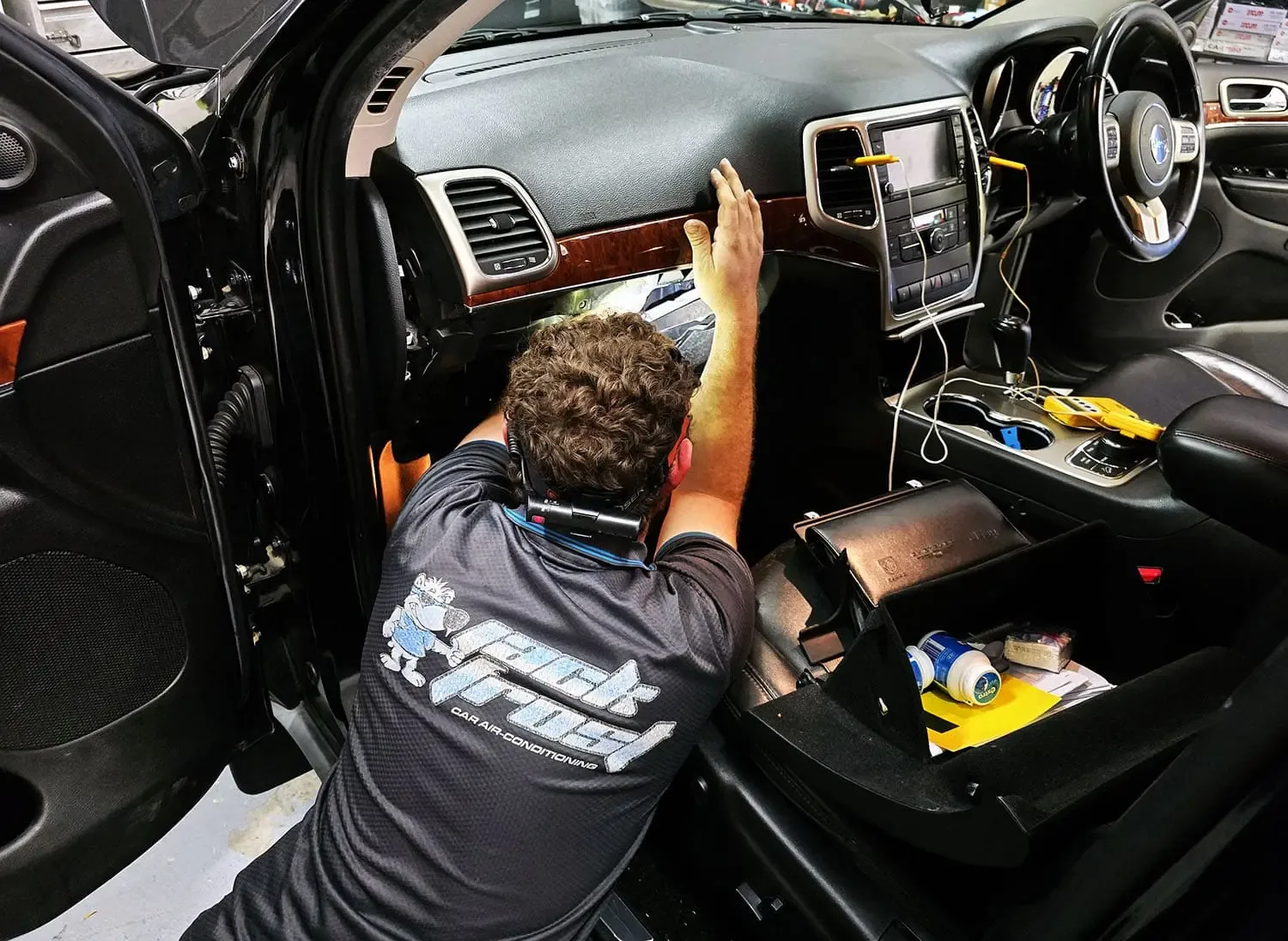
Small leaks need patient testing
The leak may not be where the symptom appears.
Refrigerant and oil can travel across nearby parts, while evaporator leaks are hidden inside the HVAC case. Diagnosis combines test results with system knowledge.
Repairing the source protects the next refrigerant charge.
Confirmation reduces the risk of replacing an unrelated part.
Once located, the leak and any associated damage are explained before repair work proceeds.
Common questions
A/C leak detection FAQs
Clear answers before you book your vehicle with our specialist workshop.
View all FAQs →Why does my car A/C keep needing a regas?
Repeated refrigerant loss usually indicates a leak or unresolved system fault. Testing should locate the cause before more refrigerant is added.
Can very small leaks be found?
Hydrogen trace gas and sensitive electronic detection can help locate leaks that may not be visible during a basic inspection.
How long does leak detection take?
The time varies with the leak size, location and vehicle access. Hidden or intermittent leaks can require more testing than obvious external damage.
What happens after the leak is located?
We explain the failed area and quote the repair. After an approved repair, the system is tested, evacuated, recharged and checked for correct performance.
Start with the right diagnosis
Book your 24-Point A/C Inspection.
Every service starts by checking what the system actually needs. Bring your vehicle to our Mount Gravatt East workshop for a clear diagnosis and the right next step.